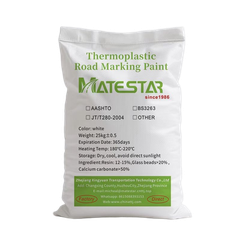

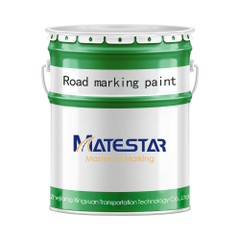
Road markings play a crucial role in ensuring smooth and safe traffic flow and improving road appearance. This is especially evident on mountain roads, where reflective markings at night can significantly enhance road safety. Two-component road marking paint is a cold-plastic product based on a methyl methacrylate resin system. It possesses excellent anti-skid and wear-resistant properties, is not easily damaged, and has excellent reflective performance. This article analyzes and discusses the application and characteristics of two-component road marking paint.
Cold-plastic road marking paint is a construction method that uses cold spraying technology to form durable and clear marking lines on the road surface. Compared with traditional hot-melt marking, cold-paint marking does not require high-temperature heating, making the construction process more environmentally friendly and requiring lower road surface temperatures, making it suitable for road marking construction under various climatic conditions. The main components of cold-paint marking are environmentally friendly coatings such as acrylic resin or epoxy resin. The paint is evenly sprayed onto the road surface using high-pressure airless spraying or low-pressure air spraying to form reflective, wear-resistant, and weather-resistant marking lines.
This type of coating can be classified into two categories according to its application method: hot-melt and cold-applied. Based on its anti-skid performance, it can be divided into three categories: ordinary anti-skid, medium anti-skid, and high anti-skid. Cold-applied coatings can be further classified into fast-drying and slow-drying types based on their drying speed.
Road surface anti-skid coatings consist of a base material and anti-skid aggregates. Glass microspheres can be sprinkled onto the coating surface. The colors of the finished coating are primarily red, green, yellow, and blue.